Starfish Enterprise Expedition 2003
HMS Russell, Malta
During World War 1 HMS Russell, a Duncan class pre-dreadnought battleship, was involved with the protection of Malta after a long campaign in the Dardanelles. On April 26, 1916 while waiting for clearance to enter Grand Harbour HMS Russell came into contact with a mine which had been laid by U73 the previous evening.
The battleship sank with the loss of over 120 lives.
In 1916 she was stationed in Imbros, and was under the command of Captain Bowden-Smith, and reputedly in very good condition. Admiral Sir Sydney Robert was also on board. The Admiralty decided to send The Russell to Malta. This was in order to fix some minor defects in the Dockyard in Valetta, and also to give the men some time ashore in a pleasant harbour.
About 100 miles from Malta The Russell met the French Battle Fleet, which was a surprise, as they had expected them to be in Valetta Harbour. Around 5.30am, they were 7 miles from the entrance to Valetta Harbour. Sir Sydney Robert was on the Bridge at the time. There were 2 heavy thuds in the after part of the ship, followed by flames and smoke rising through the quarterdeck. Sir Sydney immediately gave orders for full speed ahead with both engines, in order to try to reach the shore. He and Lieutenant Commander John Cunningham had a look at the chart, to see if they could find a suitable beach for landing.
However, there was no response to his order - this was because both engine rooms had been damaged by the explosion, and the men had abandoned the rooms due to the smoke and flames.
Sir Sydney Robert lost Nelson's "spy-glass" (telescope) which went down with the Russell. Nelson had been the friend of his great-grandfather, and Sir Sydney had taken it to sea, to avoid being destroyed by a bomb on land during the war. It was kept in a cork-lined case in the dining cabin. It now rests in 120 metres of water, in the Mediterranean, below a position where Nelson must have had it in constant use during his long blockade of Malta.
The position of HMS Russell was located by Maltese wreck researcher and documentary maker Emi Farrugia. For three years Alex Vassello (Custom Divers) of Starfish Enterprise worked closely with Emi to mount an expedition to positively identify and video survey the battleship.
In June 2003 after many months of frustrating problems the Starfish team eventually touched down in Malta. Teresa negotiated an exceptionally good deal with GB Airways and they treated us like VIP’s with our own check in desk. Each diver had 75kg baggage limit so were able to fly with essential diving equipment. A ton of equipment that wasn’t essential to the expedition i.e. scooters, decompression station and emergency drop line cylinders etc (which could all have been sourced in Malta if they didn’t arrive) were driven to Malta by two members of the team.
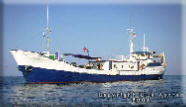
The first class treatment continued on board our dive boat Princess Duda. Team member Chris Hutchinson knew it was going to be a good trip when the first thing he was asked was how he liked his steak cooked!
Our first dive was a shakedown dive on the Polynesien in 65m which is one of my favourite wrecks.
For the Russell dives the group splits into two teams. One team dives the wreck while the other team supports. The bottom divers have it easy; they jump in and are away for 4 – 6 hrs. The support team splits into several organised groups: A Dive Marshal, deep support safety diver, shallow support safety divers (2), standby safety diver, rib crew and deck crew.
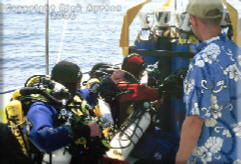
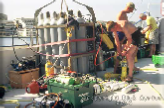
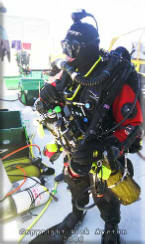
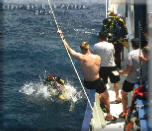
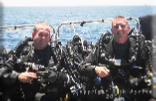
The deck crew assist the bottom divers to kit up, provide drinking water and regular hose downs. Otherwise, over heating and dehydration while kitted up in drysuits, necessary for such long dives, could be a major problem.
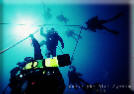
The RIB crew deployed the shot and decompression station which included several bailout cylinders and 40 pint drink containers. Adequate hydration during extended decompression is essential. The RIB attended the deco station for the duration of the dive.
Strategically timed deployment of the Deep support was designed so he met the bottom divers ascending the shot line through 50m. (So timed to keep his in water time down to a minimum) He monitored the divers gas switches and made sure they collected their ID tags as they transferred to the deco station “lazy” line. He carried bailout cylinders to assist bottom divers should they need it. Once all divers had ascended and transferred to the deco station the deep support would release the station from the shot line and send up a red SMB marked with “all divers returned”.
The station would then drift with the current. If any divers had failed to make it back to the shot line then, after a short period, deep support will release the deco station and send up a yellow SMB marked “divers missing” with the divers ID attached. This would alert the surface support teams who then watch for bottom diver SMBs.
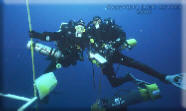
The two shallow support divers take it in turns to tend to the decompressing divers assisting them with drinks, monitoring gas switches, air breaks etc. The bottom divers were running CNSs of over a 150% so support had to keep a close eye on the divers towards the end of deco and be prepared to deal with an oxygen toxicity event.
The standby diver was responsible for preparing the emergency drop line and it’s cylinders, which would be used in the event of divers failing to return to the shot/deco station. He/she would then be kitted and ready to dive from when the first divers entered the water until the “all divers returned” SMB surfaced.
The dive marshal coordinated the support team and was the point of contact between team and boat crew.
During the expedition none of the carefully designed emergency procedures, such as use of the standby diver, were required or used.
Teresa and I were the first to enter the clear blue Mediterranean water and descend the shot line towards the Russell. The visibility was so good that the outline of the wreck which rests at 115m, started to come into view at 65m. A stunning sight in the blue Mediterranean waters. This must have spurred Teresa on as she was soon descending onto the upturned wreck while I was lagging behind trying to control £5000 of camera equipment. By the time I reached the wreck Teresa was already tying in the shot line at 110m.
With the shot line secure I released a small pellet to indicate to the surface that the remaining divers can start their dives. We descended the port side of the wreck past two stunning big casement guns pointing forward, and then onto the seabed. Unfortunately visibility on the bottom reduced to about 15m but there was plenty of ambient light.
Although the wreck is completely upside down, resting on its collapsed superstructure, as we moved towards the bow we could see that the deck level was about a meter above the seabed. We were surprised to clearly see the forward main turret as these are normally held in place by gravity and fall out when the ship turns turtle on the surface.
We finned underneath the upside down deck and emerged on the starboard side of the wreck. Past the main guns, which were half buried and past big capstans with huge anchor chains looping down to the seabed. Considering the depth there was a remarkable amount of wild life growing on the wreck.
The Russell has two anchors on the stbd bow. The massive forward anchor is in place but the aft anchor was missing with anchor chain running out of the hawse and over the upturned wreck. Finning around the front of the wreck with its unusually shaped bow, we paused to admire and film it, magnificent, silhouetted against the surface.
All too soon it became time to start heading back to the shot line. After 25 minutes run time it was time to look forward to four and a half hours deco!
The next day our team was on support.
On the following day Teresa and I decided to explore the aft section of the Russell and we started off by dropping down the starboard side about amidships. The first thing we noticed was a huge mast lying on the seabed with a big search light lying alongside. Further up the mast was what must have been an armoured gun control platform. Peering through the slits you could see a range finder and speaking tubes.
Moving off towards the stern we passed more casement guns, port holes and submerged torpedo tubes. The stern of an upturned battleship is usually the most photogenic but this is not so with the Russell. The aft end was completely blown away when she struck the mine. There was no sign of the rudder, and the prop shafts were bent through 90 degrees and disappeared into the sand. If the propellers were still attached then they were completely buried under the seabed. The room in which Sir Sydney stored Nelsons eyeglass was at the stern of the ship, which is now no longer exist, and will probably never be
found.
The damage to the stern did allow a certain amount of penetration and Dave Wilkins managed to enter the aft torpedo room. He saw torpedo tubes and racks of torpedoes, some were bent and obviously damaged which indicates that this could have been the site of a secondary explosion. Once again it was time to head for the shot line for a few hours of decompression.
During the 10 diving days of the expedition we averaged 24 hours of decompression. Each diver dived the Russell twice and we also dived an unidentified in 105m, both halves of the cruiser HMS Southwold which sank under tow, a German schnell boat, the submarine HMS Stubborn which was scuttled for ASDIC training, and the Polynesian. The expedition went like clockwork and was mostly incident free. One diver surfaced with pains in his leg so was sent to the hyperbaric facility as a precaution. The team consisted of members of Starfish Enterprise and divers known to be capable of not only diving the wreck but also working as a team. This lead to a successful expedition with over 550 hours in the water.


This clip is about 2 minutes long and 8 mb. It should start streaming after 30 seconds or so with broadband. If you have a dial up modem then now is the time to go and make a cup of tea.
Teresa is first down the shot line to tie in. Just below the external walkway are two casement guns, pointing towards the bow. Further on a gap appears between the deck and seabed. The forward turret can be seen and you can just make out a half buried gun barrel. I fin under the deck past capstans and anchor chains and meet up with Teresa on the far side. The clip ends with a shot towards the bow.
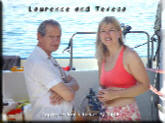
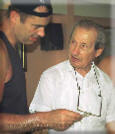
We were pleased to have Lawrence Vassallo (not related to Alex) join us for a few days. Lawrence’s father, Paul, was a survivor of the Russell sinking and used to spend hours telling stories of life on board Russell and how he managed to escape by squeezing through a porthole. Lawrence presumed the stories were embellished a little as he couldn’t imagine his grandfather squeezing through a porthole. However, after seeing our footage of some of the portholes, Lawrence started to think he might have been telling the truth after all!
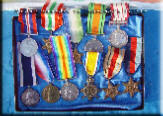
Lawrence brought along his fathers medals and service book for us to see.
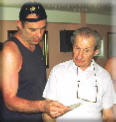
Left top & bottom: Kevin Pickering and Lawrence. Right top: Teresa Telus and Lawrence. Bottom right: Lawrence's fathers medals earned while serving with the Royal Navy
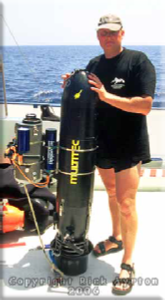
Many thanks to Rick Ayrton for the use of his photographs on this page.
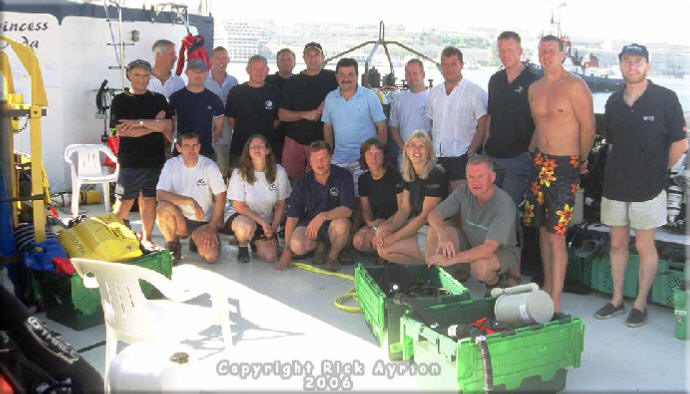
Front row kneeling, from left: Nick Gilbert, Adina Ochert, Dan Stevenson, Christina Campbell,Teresa Telus, Des Murray.
Standing, from left: Alex Vassallo, Paul Dixon, Simon Little, Gerard Punch, Rick Ayrton, Chris Hutchinson, Kevin Pickering, Emi Farrugia, Andy Avery, Gavin Hayward, George McClure, Rick Waring, Dave Wilkins, Michael Klemm (not in picture).

Another 2 minute, 8 mb clip. Teresa and I follow Dave Wilkins and Alex Vassallo to the wreck of HMS Russell. As during our previous dive the viz went from a gloriously blue 30 metres to a milky 6 - 10 metres as we touched down on the upturned hull. We dropped down the starboard side passing the walkway and a gun port. On the seabed, resting against the hull was a small admiralty type anchor. It was too big to be a fishing boat anchor but I’m not sure if it’s part of Russell’s equipment.
A short distance away was the fire control tower. Inside the slits can be seen the range finder and a speaking tube. We finned aft passed portholes and a casement gun to the shattered stern. This was a big disappointment as the stern of an upturned battleship is usually the most photogenic. All too soon it was time to ascend for a few hours of deco.


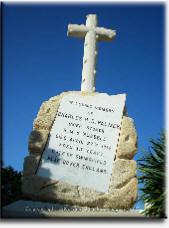
The tragic loss of life caused by the Russell sinking was never far from our minds. We took time out to visit the military graveyard on Malta and pay our respects to those who lost their lives. It was particularly sad to see that a lot of the crew passed away some days after the sinking, finally succumbing to the effects of secondary drowning, oil inhalation and other injuries.